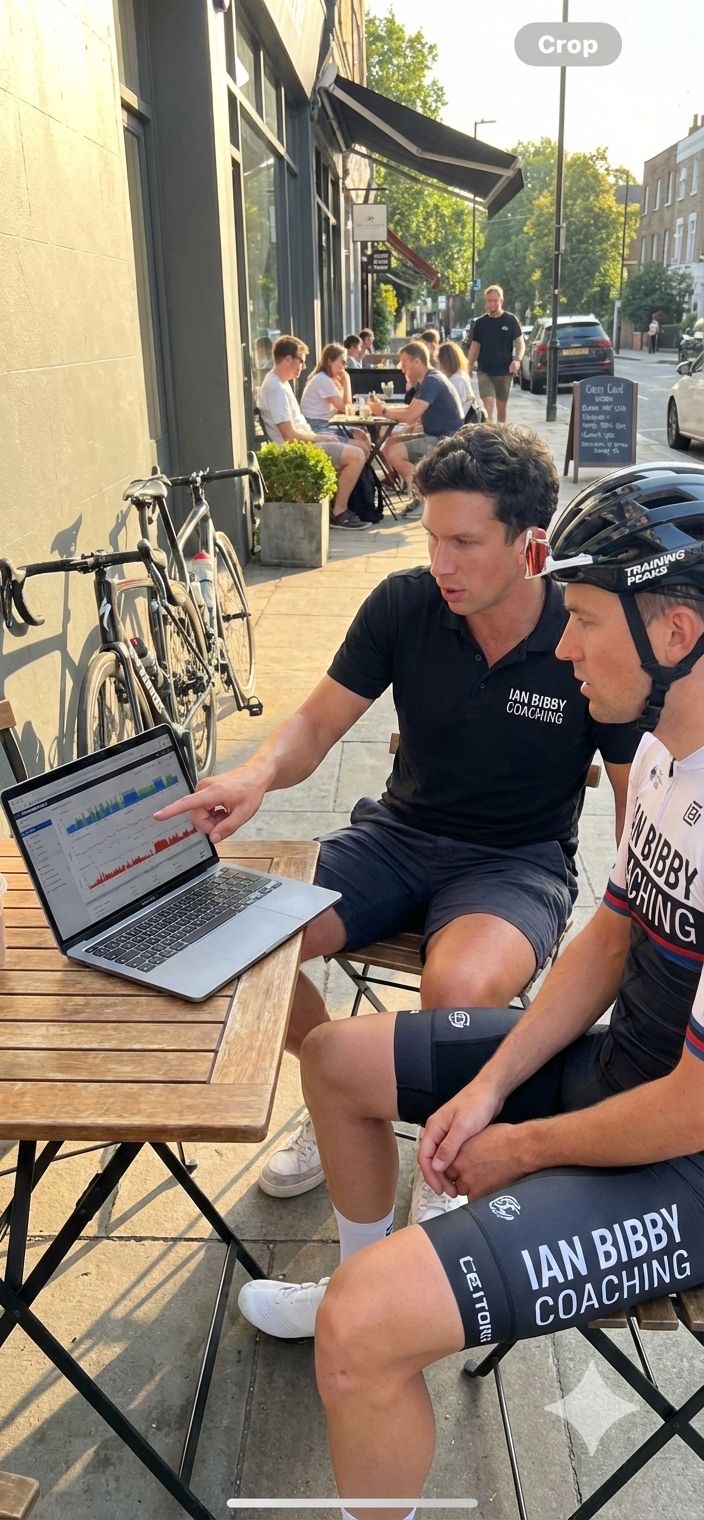
When I was racing professionally, twenty-hour training weeks were normal. Sometimes more. Long base rides through the Ribble Valley on a Tuesday, intervals on a Wednesday, a four-hour loop on Thursday, race simulation on Friday, competition at the weekend. That was the job.
Most of the riders I coach now have jobs, families, commutes, and about six to eight hours a week to train. Some have less. And here’s the thing: with the right structure, those six hours can deliver roughly eighty per cent of the gains that twenty hours would give you. The last twenty per cent requires a disproportionate amount of extra time, and most people simply don’t have it.
So let’s stop pretending you need to ride like a pro to improve like one. You need to train smarter than a pro, because you haven’t got the luxury of training longer.
Why More Volume Isn’t Always the Answer
There’s a curve in training that most cyclists don’t think about enough. The relationship between hours on the bike and fitness gains is not a straight line. It’s a curve with sharply diminishing returns.
Your first three to four hours of structured training per week deliver massive improvements. Hours four to eight add a good chunk more. Beyond that, each additional hour gives you less and less return. By the time you’re up at fifteen to twenty hours, you’re chasing marginal percentages. Percentages that matter if you’re paid to race, but not if you’re targeting a summer sportive or trying to keep up on the Saturday club run.
I’ve seen riders slogging through twelve-hour weeks, exhausted, not recovering properly, and barely faster than when they trained eight focused hours. The problem was never the volume. It was the lack of structure.
If you’ve got six to eight hours a week, that’s genuinely enough to get seriously fit. Fast on club runs, competitive in local races, smashing personal bests on climbs. But only if every session has a clear purpose and you’re not wasting a single hour on junk miles.
The Three Sessions That Matter Most
When you’ve only got three to four rides per week, you can’t afford a single wasted session. Here’s what I prescribe for the vast majority of my time-crunched athletes. These three sessions form the backbone of everything we build.
1. The Threshold Session
This is your bread and butter. Threshold work (riding at or just below your FTP) is the single most effective use of limited training time. It raises the ceiling on how hard you can ride for extended periods, which directly translates to going faster on climbs, in time trials, and on sportives.
A classic session might be 2 x 20 minutes at 95 per cent of FTP with five minutes easy between. Or 3 x 15 minutes if you’re building up. The total session, including warm-up and cool-down, fits into 60 to 75 minutes. That’s it. One hour, massive training stimulus.
If you’re newer to structured training, sweet spot work (88 to 93 per cent of FTP) gives you nearly the same benefit with less fatigue. I often start riders here and progress to full threshold as their fitness develops.
2. The High-Intensity Session
Once a week, you need something that hurts. VO2 max intervals (short, hard efforts above threshold) build your top-end aerobic engine and improve your ability to recover from surges. They’re what allow you to follow attacks, close gaps, and power over short climbs without blowing up.
Something like 5 x 3 minutes at 110 to 120 per cent of FTP with three minutes recovery. These sessions are brutal but they’re over in under an hour, and the fitness they build is disproportionate to the time invested.
Here’s a key point: you cannot do these properly if you’re already fatigued from riding too hard on other days. This is why structure matters. If every ride is moderately hard, you’ll never have the freshness to hit these efforts at the intensity they need.
3. The Long Ride
Your weekend ride. This doesn’t need to be heroic. Two to three hours of mostly Zone 2 endurance riding, with perhaps a few efforts mixed in, builds your aerobic base without destroying your recovery for the week ahead.
This is where you get outside, enjoy the scenery, maybe ride with your club. The intensity should be conversational for most of it. I know that feels counterintuitive when you’re time-poor. Surely you should be hammering every minute? No. Easy riding builds capillary density, improves fat metabolism, and gives your body a different stimulus to the high-intensity work. It’s the foundation everything else sits on.
If you can only manage 90 minutes for your long ride, that’s still valuable. Do what you can. But if you can protect one morning at the weekend for a proper ride, it makes a real difference.
Indoor Training as a Superpower
I’ll be honest, I didn’t love the turbo as a pro and I still don’t love it now. But for time-crunched riders, indoor training is genuinely a superpower, and I don’t use that word lightly.
Here’s why: an hour on the turbo trainer is worth roughly ninety minutes to two hours on the road in terms of actual training stress. No freewheeling down hills, no stopping at junctions, no soft-pedalling through villages. Every minute is a working minute, and the training stimulus is concentrated and precise.
For that threshold session I mentioned? Doing it indoors means you nail every interval at exactly the right power. No road gradient messing with your cadence, no car pulling out forcing you to brake mid-effort. The turbo gives you the most controlled, time-efficient training environment possible.
A typical weekday for one of my time-crunched athletes looks like this: get home from work, set up on the turbo, smash a focused 60-minute session, shower, done. That’s the equivalent of a two-hour road ride in terms of training load, and it’s taken an hour including the cool-down. You’ve still got your evening.
Platforms like Zwift and TrainerRoad make it more bearable, but you don’t need them. A basic smart trainer and a structured workout on your head unit does the job. Don’t let the gear be the barrier. The barrier is usually just getting on the thing.
The Commute Hack
If you cycle to work, you’ve got a hidden training opportunity that most riders completely waste. A bike commute doesn’t have to be a gentle trundle. It can be a structured training session in disguise.
I’ve had athletes with a 30-to-40-minute commute each way who turned that into genuinely productive training. The morning commute becomes an easy Zone 2 ride, loosening the legs and getting some aerobic work in. The evening commute becomes a structured effort: tempo intervals on the flat sections, a threshold effort up that hill you pass every day, sprint efforts on certain stretches.
That’s up to 80 minutes of training that doesn’t cost you any additional time in your day. You were going to commute anyway, so now it counts towards your training load.
A few rules: be sensible about traffic and don’t do eyeballs-out intervals on a busy road. Keep one direction easy. Track it properly so the data goes into your training log. And don’t do it every day. Two or three commute-training days per week is plenty.
For riders who commute by bike regularly, this alone can add four to six hours of structured training without sacrificing a single evening or weekend morning. It’s the closest thing to free fitness you’ll find.
Recovery When Time-Poor
Here’s where time-crunched cyclists get themselves in real trouble. When you’ve got limited hours to train, the temptation is to make every single session hard and skip rest days entirely. The logic seems sound: if I’ve only got six hours, I can’t afford to waste any of them going easy.
That logic is completely wrong. And it costs people fitness rather than building it.
Your body doesn’t get fitter while you’re training. It gets fitter while you’re recovering from training. If you’re doing four quality sessions in a week with no genuine rest between them, you’re accumulating fatigue without giving your body time to adapt. After a few weeks, performance drops, motivation tanks, and you end up taking a forced week off. You’ve lost more time than if you’d just rested properly in the first place.
Sleep is the most important recovery tool you have, and it’s free. If you’re getting less than seven hours a night consistently, that’s costing you more fitness than any extra training session could add. I tell my athletes this constantly: if you have to choose between a 6am turbo session and an extra hour in bed, and you’ve already trained hard this week, choose the bed. Every time.
Nutrition matters too. Eating properly after hard sessions (protein and carbohydrates within an hour) isn’t optional when you’re training on limited time. Your body has a smaller recovery window between sessions, so you need to give it every advantage. Skimping on post-ride fuel because you’re trying to lose weight at the same time is a recipe for stagnation.
And rest days are non-negotiable. At least one per week, ideally two. If that feels like wasted time, reframe it: rest days are where the fitness you’ve earned gets locked in. Skip them and you’re throwing away the gains you worked so hard for.
A Sample 7-Day Plan
Here’s what a typical week looks like for one of my coached athletes, a full-time worker targeting a summer sportive, with about seven hours available. This isn’t a one-size-fits-all prescription, but it shows how the pieces fit together.
Monday: Rest day. Completely off the bike. Walk the dog, stretch, do some core work if you fancy it. No riding.
Tuesday: Turbo session, threshold intervals. Warm up 10 minutes, then 3 x 12 minutes at 93-97% FTP with 4 minutes easy between. Cool down. Total: 65 minutes.
Wednesday: Easy commute or complete rest depending on how Tuesday’s session went. If riding, keep it genuinely easy. Zone 1 to 2 only.
Thursday: Turbo session, VO2 max intervals. Warm up 10 minutes, then 6 x 3 minutes at 110-115% FTP with 3 minutes recovery. Cool down. Total: 60 minutes.
Friday: Rest day. Legs up. Good meal. Early night.
Saturday: Long ride outdoors. 2.5 to 3 hours, mostly Zone 2 endurance pace. Include 2 x 10 minutes at tempo effort on rolling terrain to add some quality without turning it into a hard session.
Sunday: Easy spin, 45 to 60 minutes at recovery pace, or complete rest. Listen to your body.
Total: approximately 6.5 to 7.5 hours. Two genuinely hard sessions, one long ride, and enough recovery to absorb the work. Simple, effective, sustainable.
As we get closer to the target event, I’d adjust the intervals, increase the long ride duration slightly, and add race-specific efforts. But the skeleton stays the same: hard days hard, easy days easy, and enough rest to actually get fitter.
When to Add Volume vs Intensity
This is a question I get constantly from athletes: “I’ve got a bit more time this week, should I ride longer or ride harder?”
Here’s the decision framework I use.
Add volume when you’re consistently completing your current plan without feeling buried, your long ride feels comfortable, you’re in a base-building phase more than eight weeks from your target event, and the extra time won’t cut into sleep or recovery.
Add intensity when you’re within eight weeks of your target event and need to sharpen up, your FTP has plateaued despite consistent training, or you’re recovering well between sessions and feel fresh on hard days.
Do neither when you’re feeling consistently fatigued, sleep quality has dropped, life stress is high, or you’ve just increased your load in the past two to three weeks and haven’t adapted yet.
The biggest mistake I see is riders adding both volume and intensity at the same time when they get a burst of motivation. That’s the fast track to overtraining. Change one variable at a time, give it three to four weeks to take effect, then reassess. Patience is the hardest skill in cycling, and it’s the one that separates riders who improve year on year from those who keep burning out.
The Exact Problem I Solve
If you’ve read this far and you’re nodding along (you’ve got the motivation but not the time, you want to improve but you’re not sure how to structure what you’ve got) this is the exact problem I solve for most of my athletes.
The majority of riders I coach are people with full-time jobs who want to get the absolute most out of their limited training hours. We build a plan around their life, not the other way around. Sessions that fit their schedule, adjust when life gets in the way, and build towards the goals that matter to them.
You don’t need twenty hours a week. You need a proper plan and someone who knows how to make six hours count.
Find out more about coaching and let’s build a plan that works for your life.
Got a question about training with limited time? Drop me a message. Always happy to chat, whether you become a coached athlete or not.