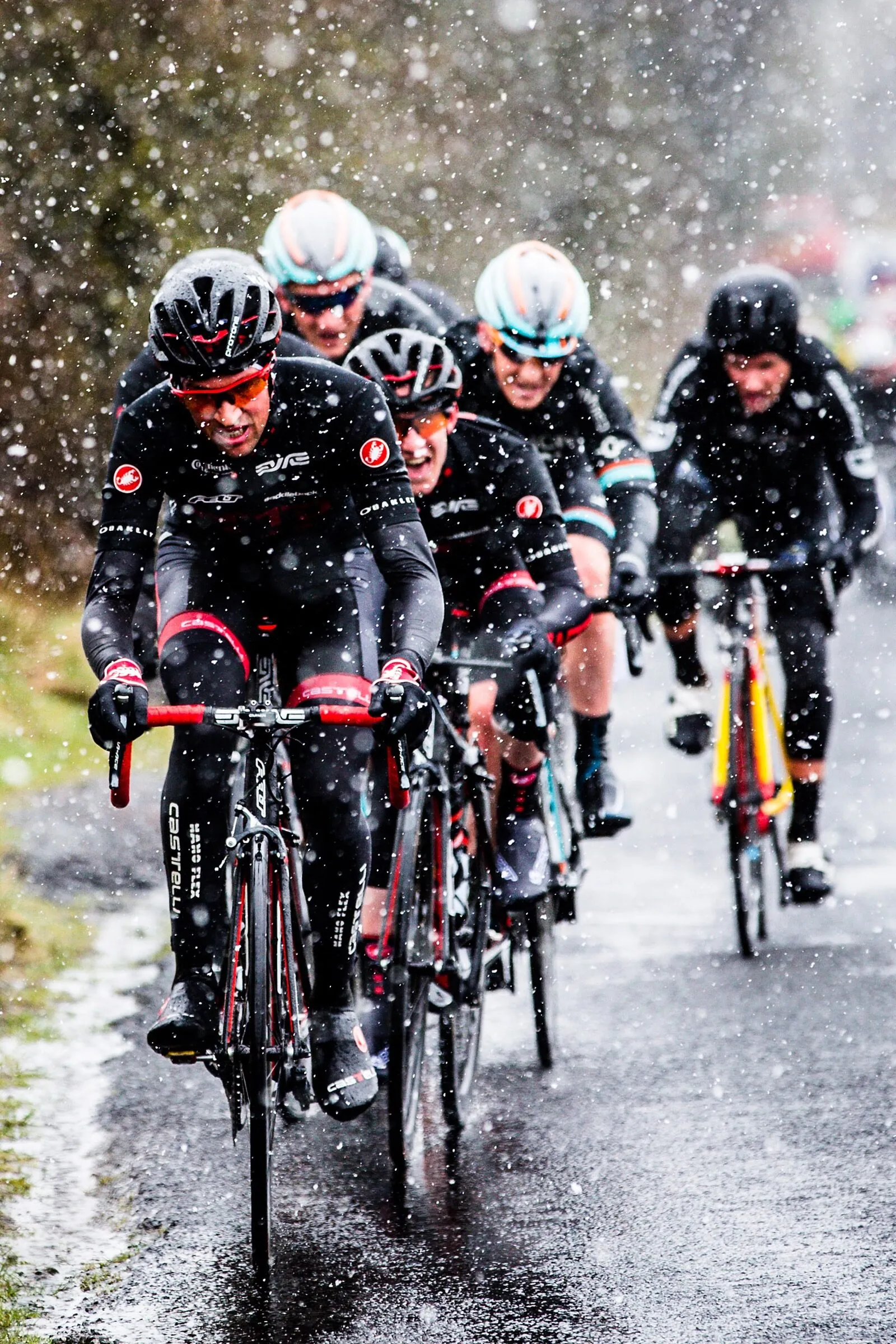
I’ve ridden through fifteen professional winters in Lancashire. Snow blowing sideways across the Trough of Bowland, black ice on the lanes around Clitheroe, pitch darkness by half three in the afternoon, and the kind of horizontal rain that finds its way through any jacket ever made. Some of those winters were brilliant for my fitness. Some were a waste of time. The difference was never the weather. It was whether I had a plan.
The difference was never the weather. It was whether I had a plan.
Here’s what I learned about making winter count, and how you can use those cold, dark months to come out swinging in spring.
The Myth of Junk Miles
Let’s get this one out the way first because it’s the biggest misconception in cycling: winter does not have to mean months of slow, boring base miles.
The old-school approach was ride steady from October to February, never push above Zone 2, and save the intensity for spring. I followed that advice early in my career and all it did was make me slow and heavy by Christmas, then scrambling for fitness come March. The riders who were flying in spring weren’t the ones who’d been plodding around for five months. They were the ones who’d trained with purpose the whole way through.
I’m not saying you should be smashing VO2 max intervals in November. But the idea that any ride above conversational pace in winter is somehow harmful is nonsense. Your body doesn’t know what month it is. It responds to stimulus and recovery, full stop.
A well-structured winter includes easy riding, threshold work, short sharp efforts, and recovery. The proportions shift (more volume at lower intensity, less high-end work) but keeping some intensity maintains your top end and stops you losing months of fitness you’ll only claw back later.
The key phrase is purposeful riding. Every session should have a reason. If it’s an easy spin, keep it easy. If it’s intervals, do them properly. What you want to avoid is the no-man’s-land ride where you go out with no plan, ride moderately hard, come home knackered, and haven’t trained anything specific. That’s a junk mile.
Indoor vs Outdoor: An Honest Comparison
I’ll be straight with you: I don’t love the turbo. Nobody does, really. But I’d be lying if I said it wasn’t one of the most valuable tools in my training across all those winters.
When the turbo is genuinely better:
- Ice and dangerous conditions. There’s no training benefit to a broken collarbone. If the roads are lethal, stay inside. Simple.
- Short, high-intensity sessions. If you’ve got 60 to 90 minutes and want to do threshold or VO2 work, the turbo is actually superior. No junctions, no descents, no soft-pedalling. Just uninterrupted effort. A 60-minute indoor interval session can be worth more than two hours on the road in terms of training load.
- When daylight is non-existent. Riding in the dark with traffic on wet roads is a risk-reward equation that rarely makes sense for a Tuesday evening session.
When you should get outside:
- Longer endurance rides. Four hours on a turbo is grim and unnecessary. If you can get a dry Saturday or Sunday, get out and ride. The mental benefit of fresh air and different terrain is massive.
- Skills and bike handling. You don’t improve your cornering, bunch riding, or bike feel on a turbo.
- Mental health. Getting outside, even in rubbish weather, keeps you sane. A two-hour ride in the cold rain does wonders for your mood compared to staring at a screen in a garage.
My approach was roughly this: two or three indoor sessions during the week (focused, structured, 60 to 90 minutes), then one or two outdoor rides at the weekend when conditions allowed. If you can only manage one outdoor ride a week in the depths of December, that’s fine. Make it a good one and do the rest indoors with a proper plan.
Platforms like Zwift and TrainerRoad have made indoor training far more bearable. But don’t get so hooked on the virtual world that you forget to ride your actual bike on actual roads.
The Winter Training Block: A 12-Week Structure
Here’s a framework I’ve used with my coached riders and adapted from my own pro training. It runs from roughly November to the end of January, setting you up perfectly for a spring build.
Weeks 1 to 4: Foundation
The focus here is volume and aerobic base, with just a touch of intensity to keep things ticking. Think three to four rides per week. Most of your riding is Zone 2, proper easy, conversational pace. But once a week, throw in a session with some tempo or sweetspot work: maybe 3 x 10 minutes at 85 to 90 per cent of FTP. This keeps the engine turning without burying you.
Weeks 5 to 8: Development
Now we start adding more structure. Two quality sessions per week: one threshold-focused (2 x 20 minutes at 95 per cent FTP, for example) and one with shorter, harder efforts (6 x 3 minutes at VO2 max pace). Keep the long ride going at weekends and maintain your easy rides. This is where the real winter gains happen. Your body is rested from the season, you’ve laid down aerobic groundwork in the first block, and now you can absorb harder training.
Weeks 9 to 12: Sharpening
Intensity goes up another notch. You’re doing race-specific efforts: hard group rides if you can find them, or structured intervals that mimic the demands of your target events. Sprint work, over-under intervals (alternating above and below threshold), and efforts that test your ability to recover and go again. Volume might come down slightly as intensity peaks. By the end of this block, you should feel sharp, fit, and genuinely ready to race.
Weeks 1-4: Foundation
Weeks 5-8: Development
Weeks 9-12: Sharpening
Build in a recovery week every third or fourth week. Drop the volume and intensity by about 30 to 40 per cent. Your body needs that time to absorb the work. Skip the recovery weeks and you’ll just accumulate fatigue without getting fitter.
Strength Training for Cyclists
This is where most cyclists lose free speed. Off-bike strength work in winter pays massive dividends in spring, and I wish I’d done more of it earlier in my career.
You don’t need to become a bodybuilder. You need functional strength that transfers to the bike. Here’s what I recommend:
Squats. Back squats, front squats, goblet squats. Pick your poison. Three sets of six to eight reps at a challenging weight, twice a week. They build the quads, glutes, and core stability that drive your pedal stroke.
Deadlifts. Brilliant for the posterior chain: hamstrings, glutes, lower back. These muscles stabilise you on the bike and generate power, especially out of the saddle.
Core work. Not sit-ups, but proper core stability. Planks, side planks, dead bugs, pallof presses. A strong core means more power reaches the pedals instead of being lost through a wobbly torso. Ten to fifteen minutes after every gym session.
Single-leg work. Bulgarian split squats, step-ups, single-leg deadlifts. Cycling is a single-leg sport, and these exercises address imbalances and improve stability.
Squats
Deadlifts
Core Work
Single-Leg Work
Two gym sessions per week is plenty. Don’t try to do a hard interval session and a heavy gym session on the same day. That’s a recipe for being wrecked. As you get closer to racing season, taper the gym work gradually from about six weeks out.
Cyclocross as Winter Training
If you want my honest opinion on the single best thing you can do for your road season over winter, it’s this: race cyclocross.
I’m biased, I know. I won the National Cyclocross Championship and raced CX seriously for years. But I’m biased because it works. The benefits are ridiculous:
Why CX Works
Threshold fitness without the monotony. A CX race is 45 to 60 minutes of eyeballs-out effort with constant surges, recoveries, and redlining. It’s basically the best interval session you could design, except you’re racing and having a laugh with mates in a muddy field instead of staring at a power number on a screen.
Bike handling. Cornering on slippery grass, riding off-camber, shouldering the bike over barriers. All of this translates directly to better handling on the road. After a winter of CX, you’ll corner with more confidence and handle sketchy surfaces without panicking.
Mental toughness. CX hurts from gun to tape. No hiding in the bunch, no soft-pedalling. You learn to dig deep when your legs are screaming and your lungs are burning. That mentality carries straight over to road racing.
It’s genuinely fun. The atmosphere is completely different to road: heckling, cowbells, people handing you beer in the pits. You’ll finish covered in mud, completely spent, and grinning. It reminds you why you fell in love with bikes in the first place.
Even a handful of local CX races through winter gives enormous fitness and skill transfer. You don’t need a fancy CX bike. An old frame with knobbly tyres will do.
Mental Health and Motivation
Let’s talk about the elephant in the room. Winter can be grim for your head. Short days, cold weather, dark mornings, dark evenings. It’s easy to fall into a rut where you’re not training, not motivated, and feeling rubbish about it.
I’ve been there. Even as a professional with racing commitments, there were winters where getting on the bike felt like pulling teeth. Here’s what helped me:
Set process goals, not just outcome goals. Instead of fixating on “raise my FTP by 20 watts by March,” focus on “complete four training sessions this week.” Process goals are within your control. String enough good weeks together and the results take care of themselves.
Train with mates. A solo turbo session in a cold garage at 6am is soul-destroying. But arrange to meet a mate for a Sunday ride and suddenly you’re out the door without thinking about it. Accountability and camaraderie are the best motivation tools there are.
Mix it up. Throw in a CX race. Try a different loop. Do a Zwift race for a laugh. Ride the mountain bike. Variety keeps things fresh and stops training feeling like a chore.
Accept that some weeks will be rubbish. You’ll get ill. The weather will be truly awful. Work will be mental. Don’t beat yourself up, just get back on it when you can. Consistency over months matters far more than perfection over days.
Get outside in daylight when you can. Even a 30-minute walk at lunchtime helps. Natural light makes a real difference to your mood through the dark months.
Winter Nutrition
Here’s a mistake I see all the time: riders cut their fuelling in winter because rides are shorter and they’re worried about putting on weight. This is backwards.
Don't Cut Fuel in Winter
Yes, you might be riding fewer hours than in summer. But if you’re training properly (gym sessions, structured intervals, CX races) you’re still putting significant demands on your body. Under-fuel that and you’ll recover poorly, get ill more often, and your training quality will nosedive.
Carbohydrates are still essential. Match them to your training load. Big session day? Eat more carbs. Rest day? Scale back, but don’t cut them out entirely.
Protein matters more in winter, not less. If you’re doing gym work (and you should be), you need protein to repair and build muscle. Aim for a decent portion at every meal. A protein shake after gym sessions is an easy win.
Don’t neglect fruit and veg. Winter is prime cold and flu season. Good nutrition is the foundation of a strong immune system, and a strong immune system keeps you training consistently. Consider a vitamin D supplement through the darker months.
Stay hydrated. You might not feel as thirsty in the cold, but you’re still sweating during indoor sessions. Dehydration affects performance and recovery just as much in January as July.
Don’t fear winter weight. A kilo or two above race weight is completely normal. Trying to stay race-lean through the off-season usually means under-eating, which means under-recovering, which means rubbish training. Fuel the work, and the weight sorts itself out when training ramps up in spring.
Make This Winter Count
Winter is where seasons are won and lost. The riders who arrive in spring fit, sharp, and hungry are the ones who used those dark months wisely, not the ones who hibernated until March and then panicked.
Winter is when coaching makes the biggest difference. It’s easy to drift without structure, to lose weeks to aimless riding or no riding at all. My coached riders start spring ahead of the pack because they’ve had a proper plan, accountability, and someone to adjust the training when life gets in the way.
If you want to make next winter the one that transforms your season, get in touch about coaching and let’s build something that actually works.